Skip to content
Neodigit

Post-quantum cryptography startup (confidential)

Cryptographic discovery web platform for a deeptech startup

12-month engagement, from POC to market launch: the web platform that exploits the data of a post-quantum network probe.

3 daysto a first demo, free of charge

Duration
Then a 12-month engagement
Sector
Cybersecurity
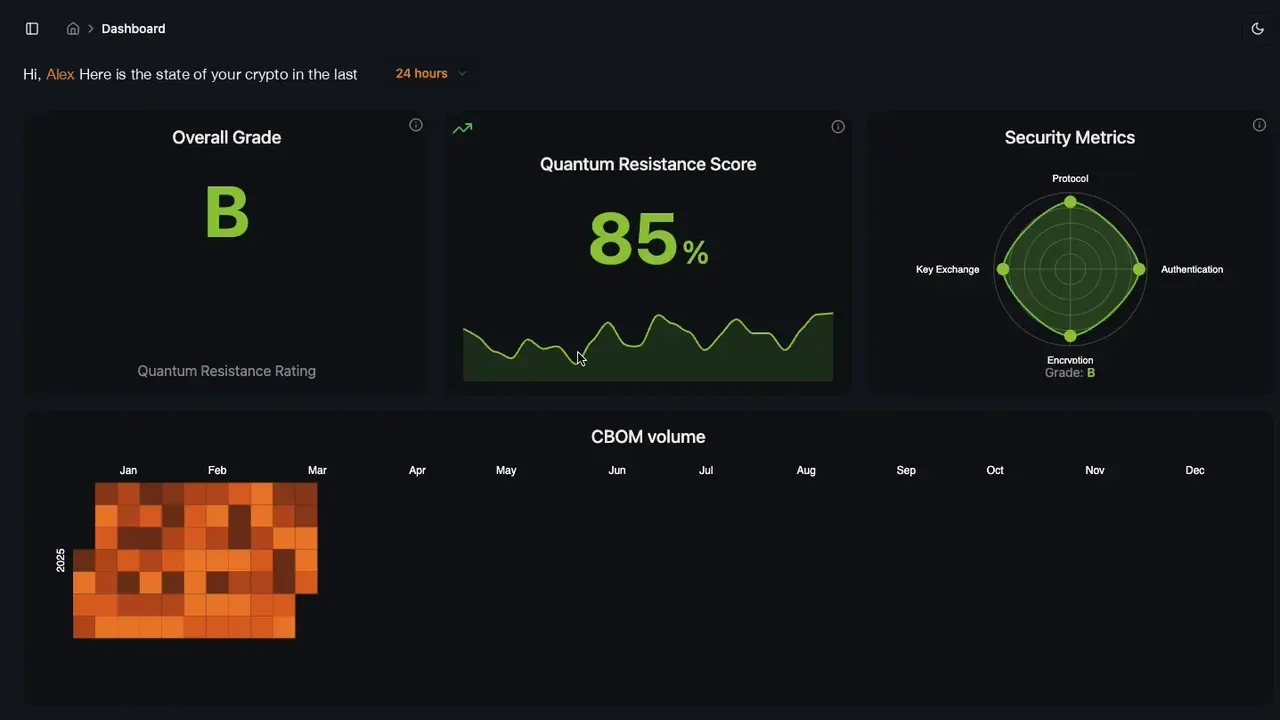
Platform dashboard: overall grade B, quantum resistance score 85 %, security radar.
The problem
A product to show to future customers.
What I delivered
A free demo in 3 days, then a 12-month engagement through to the first customers.
The result
  • A free 3-day POC (multi-tenant interface, KPIs, design system) that led to a 12-month engagement
  • Before: shifting priorities and unformalized expectations. After: defined scope, objectives per phase and verifiable proof they were met
  • Product on the market: first customers, trade show demos, fundraising
  • In-house developer trained and autonomous on the project after a two-month handover

Technologies : Next.js, Go, ELK, Redis

Project details

Context

A French startup specializing in post-quantum cryptography was developing a device able to probe the exchanges on a network to extract SBOMs and cryptographic assets, in order to analyze the post-quantum resistance of those exchanges. The missing piece was what makes this data usable: nobody in-house could propose a web discovery platform that integrates this information and presents it. After a scoping meeting, we came back to the team with a POC and implementation ideas, rather than a plain commercial proposal.

The challenge

The POC, offered free of charge, took about three days of development: a complete multi-tenant interface with multiple KPIs, charts and a design system. It let the team quickly picture a product they had not yet envisioned or visualized. The real difficulty of the project then turned out to be organizational rather than technical: shifting priorities, sometimes disconnected from the end customer's needs, and effort that was hard to perceive. More deeply, the project had not really been thought through and expectations had not been formalized.

The solution

We worked full time for 12 months, from design to training an in-house developer, through development and presentations to management. To stabilize the project, we set up project management rituals: sprints, planning, dailies, retrospectives and phase closures. Each phase had a defined scope, set objectives and verifiable proof that they were met. We also guided management to identify the topics to work on before moving forward. The handover lasted two months, after which the in-house developer took over the project autonomously. In hindsight, we should have imposed the roadmap, milestones and objectives of each phase earlier.

Jimmy Lefevre

A similar project?

Reply within 24 business hours.contact@neodigit.fr+33 3 74 47 32 20